Episode 93: Seeing Every Student: Intentional Inclusion in the World Language Classroom with Emily Ibrahim
Feb 18, 2026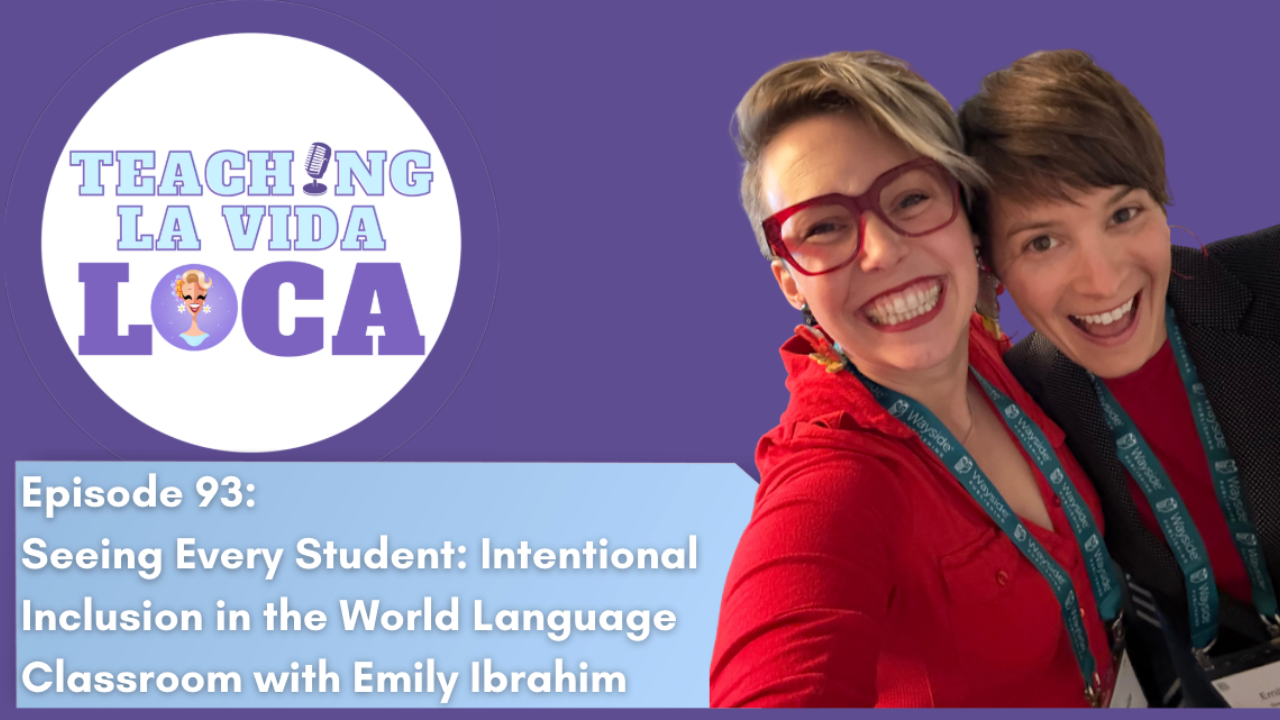
I am so grateful for Emily joining me for this podcast! I hope you'll check out her sequel to the beloved "Edi el Elefante"!
Links mentioned in this episode:
Emily Ibrahim
Hannah Sullivan
Let's Connect!
My Blog
My YouTube
My Instagram
My Website
My TPT store
Join La Familia Loca PLC
Transcript
Annabelle Williamson
Hi, hello. Welcome to Teaching la vida loca. Today is a very special episode. I've been doing more of a more of like guest episodes lately, and I think it's because my life and my world is so busy that sitting down when it's just me feels hard, but sitting down when it's I get to talk to a friend, it feels like I get to talk to a friend so I can make space and time for it. So, I'm very excited today because I have a guest to talk to us about how we can be more intentional and inclusive for our students with disabilities in our classroom. And this is somebody who I was lucky enough to reconnect with and sit next to at SCOLT last year, and we sat in an incredible session together, and it was one that I did, like a million takeaways. Hold on. Why am I blanking on her name? I'll think of it, Charlotte. I mean, I love her. Hold on. I'll think of it. Just give me a minute. Anyway. So, we sat in the back of her session, and we cut up together and laughed. And this, this is the person with the world's most recognizable laugh on the planet. You hear this person laugh, and you go, where is Emily? Where is Emily, so I have the world-renowned author you probably own, Edi el Elefante, oh, stop it.
She's shaking her head like she's not you. I know that there are teachers around the world with your book, because I've met teachers in in Australia with your book. So literally, world renowned author Emily Ibrahim who has recently been a presenter for La Familia loca PLC and conference in the cloud, teaching us all Egyptian Arabic using acquisition driven instruction. And she's just a joy to be around. So very grateful to have you. If you want to give a better introduction than I did, you can do that, and then you can answer my first question, which is, can you tell us a little bit about your background and how it is you came to focus on supporting students with disabilities, especially in World Language classrooms.
Emily Ibrahim
Hi, well, hello, I liked your introduction, so I'm not going to add anything to that. So, thank you. Yeah. How did I get to where I am today? So, when we first moved to where we're living now, I got just a little part time job teaching Spanish at a small, private Elementary School. And after I got the job, they said, oh, by the way, we have an inclusive program for kids with Down syndrome. They're included in everything with the class, but, you know, they go all the special areas with their classes, music and art, blah, blah, blah, but they've never been to Spanish. Would you be willing for them to come to Spanish class? And I was like, Sure. I would love that. I've never taught kids with Down syndrome, I've never studied how to teach kids with Down syndrome, but I would love for them to come to Spanish class, and the admin, pretty much straight up, said, we don't actually expect them to learn Spanish. We just want them to do something fun, kind of like a brain break. And so that was their expectation.
But I welcomed them the first year, they came by themselves, just as a group of the kids with Down syndrome, not with their classroom peers, because the admin, I guess, thought they couldn't, you know, keep up with their peers. And the expectations, not on my part, but on the part of others, were pretty low. I had one teacher that was like, one of their teachers say to me, like, this is stupid. Like they have enough problems with English. Why would we expect them to learn another language? Like this is pointless. But they started learning Spanish, and they were doing amazing. And by the end of that year, I was like, these kids are ready to be with their peers, like they don't need to come by themselves. So, the next year, they came to class, integrated with their peers, and they did great. I would say by the end of that school year, most of them were on par with their peers. I would say there was at least one that was probably ahead of a lot of her peers and all of them, you know, no matter no matter their cognitive ability, no matter their verbal ability, they were all showing me signs that they were acquiring Spanish. And I was like, the world needs to know this.
The world needs to know that these kids can do what, at least in American society, we say is what smart people do, which is learning another language. And these kids with Down syndrome can do that. So I decided to pursue a doctoral degree, not because I wanted to be doctor or university professor, but because I wanted to do like, solid academic research, demonstrating what I already knew from my own experience as a teacher that kids with Down Syndrome have the ability to learn a foreign language, so that's what I did for my doctoral studies, teaching kids with Down Syndrome and also kids that had a dual diagnosis of autism and just had the joy of exceeding expectations and watching them flourish and learning Foreign language. And so now I want to equip other teachers to get to do the same thing.
Annabelle Williamson
I think that's really, really cool. And I think that I worked once in a school, a public school, that also had a full inclusion model where kids spent the whole day with their peers, went to everything, all of their classes, with each other. And one thing that was a stark difference that I noticed from other schools where I had worked was that I had kids at that school participated with the students with learning differences and disabilities, equally to other peers in a way that like, let's say, when I said, Okay, let's get up and do a brain break, everybody was just playing with each other as normal, whereas in other schools, where almost similar to what it sounded like you started with, their kids were pushing in only during music and only during Spanish and only during Art. And so, kids were like flooding to play with those children, because they were seen as like this, whoa. It's, it's, you know, oh, it's such and so who we only get to see one time a day or and it almost created more exclusive feelings I felt than an environment where they just were always with their peers. And I'm really glad that you pushed for like they should just, they should just come with everybody else. Because for me, I noticed greater growth in those kiddos when it was just, they were just part of the class and part of the classroom community. I don't know. I don't know if you saw any similarities or differences.
Emily Ibrahim
Yeah. I mean, I think Spanish was the kind of, the one thing where, in the past, they were excluded, like they were with their peers. You know, they were, they were occasionally pulled out for kind of additional help and support. But Spanish was the one place where they were included. But it was, it was wonderful when they began to be included, because their peers were watching them, like, learn and realizing, like, wow, they can do this. And or, there was a girl that was already bilingual. She was growing up in a bilingual home, and so like seeing that, oh, she can actually do this better than me Was really cool. So yeah, I think was better when they were included.
Annabelle Williamson
Yeah, it's kind of like flipping the script on what prior beliefs those some of those kiddos might have, you know what I mean, and giving them a place to shine. On that note, I know that I, regardless of what school I've worked at, I have faced many barriers when it comes to serving students with disabilities, and some of those barriers are actually like you just mentioned, this idea that, oh well, you don't actually have to do anything with them. What you know, like their para just needs a break. You're not expected to do anything. And that became problematic in public schools, where I had sometimes seven kids who had a full-time para with them that were just dropped off to Spanish with a class that I already had 30 kids in, and that felt
Emily Ibrahim
and their assistance didn't remain with them?
Annabelle Williamson
correct. So, I was like the break in the day, which was impossibly challenging, whereas once I was loud enough about the legal issues behind that at this particular school, and we got a para with them, the then expectation of flipping the script and saying, no, I know that you have no expectation of me and of them during their time here, but I am very confident in what they can do if you just give me that opportunity. So, what are outside of those and some that you faced, what are some others that you believe are barriers that we often see in a world language teacher classroom. And how can teachers work to remove those barriers, or work around them, work within them?
Emily Ibrahim
Yeah, so when I think of barriers in the context of the foreign language classroom, and this is this would be true in other classrooms as well, but like things that we can think about, you know, I can't necessarily control what the admins are doing, or all of those things, but in my classroom, with the student that I have, I like to kind of divide those barriers between internal and external barriers that a child with disabilities might have. So internal barriers might be things like a short attention span, or especially for kids with autism, maybe difficulty attending, like paying attention to the relevant visual stimuli that's in the class. Maybe sensory needs that a child might have their mood and energy level or behavioral difficulties that they might have, and these are things that typically developing children have as well, but they're they might be more pronounced in a child with disability.
So those are kind of internal barriers. And though they're internal, they're very relevant to the classroom, because if the child is struggling with one of those internal barriers, they're not able to attend to the language right, and to actually be acquiring the language, and they might be distracting other class classmates as well, and then external barriers that you might find in almost any classroom, but some are specific to the foreign language classroom, would be like changes in schedule or routine. That might be something that's happening outside of your classroom that you can't control. It happens a lot with kids with learning disabilities. They might end up coming late to class because, you know, they were having some other kind of remedial instruction or something. Distractions. It might be an object that they have, a preferred object, that they would rather pay attention to than you, or it might be other people in the room that are distracting to them, and then specifically in the foreign language classroom, difficulty understanding so that could be difficulty understanding instructions, especially if the instructions are given in the l2 in the second language, difficulty in understanding language, especially if It's kind of more complex. And then difficulty understanding activities, how to actually follow through and complete the activities.
So, those are barriers that we might encounter. I think any child with a disability, exactly which barriers they have are going to be different, but those are pretty kind of common, general barriers that are going to find, and how can we support them? I like to think of behavioral support and content support. So behavioral support is support that they're going to need in any classroom, but you have to offer it for them to be successful in your classroom, they have to receive that support. You might think it's not your job, but it is your job like you want to find if there are ways that other people that you can help and offering the support? Yes, but they need that behavioral support. So, they might need extra reminders more than a typically developing child, and those can be verbal reminders, or they can be visual. Maybe you need to have you know that this child, this student, struggles with something in particular that you have to remind them often. You might have that reminder written down and you can just maybe discreetly show it to them. Or maybe they need a picture because they aren't strong readers, so you have a picture to remind them of whatever it is that they need reminding, or maybe it's a particular gesture that you can use to remind them.
Two really important things that we need to think about are sensory support. Students with disabilities might need extra breaks. They might need extra movement. I know you're really big on like brain breaks and all of that, and it's good for all of our students, but students with particular disabilities might need more of that. They might need a place where they can go to calm down or to just kind of be alone or being quiet. So do you have that, a place like that in your room, or do they have the kind of freedom and permission to get up and stand and move or walk if they need to or do, they have the freedom in your classroom to fidget. Those things are important for some students to be able to actually attend to the content. So be sure to take lots of breaks and allow for extra breaks for those students that need them. And then another thing that we can easily control is routine, routine. I think routine, routine is really important for me. I was just telling my husband how, like, right now I don't have a particular job, I'm doing a million things, but I don't have structure in routine. That's kind of part of my life, unless I create it right now. And so, I'm, you know, kind of struggling with being the most productive I can be with my time, and establishing healthy routines with exercise and whatever, because I don't have enough structure. And if, for me, like an adult needs that routine. How much more do children and students need that routine? But even more so students with disabilities thrive on routine. And I know that we love variation and we love things that are novel, but I think you can do novel things within a structured routine.
Annabelle Williamson
I'm so in agreement with, like, so much that you said, and I'm gonna, I'm gonna start now, because I'll never remember all the things I wanted to connect. I think that I'll go backwards. The first thing is, like, the routine piece, one of the reasons you mentioned, like, changes in routine can be a really big challenge for. For any kid, but most, most importantly, our students with disabilities, and I had several students at my last school who were ADHD, and I knew if there was a change in the schedule or we were doing something slightly different, it took me about three minutes total at the beginning of my day to stop into their 3 5th grade classrooms and just say, hey, I wanted to let you know that today, instead of Spanish, I saw that you are going to go to an assembly. And I just wanted to give you that heads up, because taking those three minutes out my day could save an absolute meltdown for this child at 1pm when they were supposed to go to Spanish. You know what I mean? That's one and then two.
Anytime I am doing an activity outside, I've had people ask me, well, why don't you just take, like, line the kids up, since they're used to lining up outside your classroom anyways, for the password, and just walk them outside. And I never in a million years would start with that, because for all of my student’s sake, we start with the exact same routine, whether we are doing class inside or outside. And second, for my students with disabilities, the simple task of still coming in, saying the password, doing your do now, going through the agenda is so crucial that after the agenda, they know, they don't know what's coming in Spanish that we're going to do some sort of activity. But the consistency of that part that I can give them for the first five minutes of every class, every single day, without fail, is so crucial to everybody being able to have a successful class the whole way through, right? So, I love that.
And then something else that you said regarding sensory support, like fidgeting and moving, something I added to my classroom this year because of watching a presentation by Andrea EIder, who's a Familia local member. She has a specific like fidget drawer that anybody who needs a fidget just goes and grabs a fidget. And its fidgets that she knows that aren't going to bother her. They're not noise makers or whatever. They're simple things that can be so crucial for a kid just to have. And I also am a person who my kids eyes go wide when they realize like they can stand up behind their chair or walk around, and I mean, what, whatever they need to be able to be focused or be present, and when they are not in a space to be focused or Be present, the very first thing I introduce day one of my classes, my calming corner, where they can just go and there's breathing activities, there's puppets there, there's a timer, there's all sorts of different like things, and I'll link a blog to it, but just that they can self-opt into and for me, I'd rather them self-opt than me having to, like, try and pull them back in and pull them back in and feel frustrated if it's not working, if a kid can self-opt and let me know, oh, I'm just not in a good headspace right now. Great. I love that I have a way for them to advocate for their needs and just and just do it rather having to ask, does that make sense? Absolutely. Yeah, love that.
Annabelle Williamson
So, speaking of specific to acquisition driven instruction, you mentioned acquiring several times, I know that you teach with an acquisition focused lens. What are some things that we do naturally within acquisition driven instruction that helps make learning more accessible and acquisition for all students, including our students with disabilities?
Emily Ibrahim
Yeah, pretty much everything that is good acquisition driven instruction practice is good for students with disabilities. It's good for all students, but these things are maybe more necessary for students with learning disabilities. So, you've probably heard of all these things, and I think it's just it's good to use them a lot. So first is signs and gestures. Signs kind of being more towards like what we might think of as ASL and gestures, just being some gesture that you have created that maybe connects well with the meaning or whatever you're trying to communicate. So, using signs and gestures as much as you need to support comprehension, and allowing students to communicate using signs and gestures as well, like allowing that to be a valid mode of communication in the classroom, because not all students are able or are comfortable producing language in the l2 especially our students with particular disabilities, and accepting signs and gestures as like a valid way of communicating is great, but it's also it really helps with comprehension. So that's really big modeling, modeling what you want the student to do, so not just giving verbal instructions, but actually doing what you say. So very simple example, but when you say, stand up. Like, actually do it. Stand up. You know, when you say, turn around, actually do it so that they're seeing it being done, not just hearing the word, using lots of pauses and using repetition, saying the same thing more than one time. So, using pauses and using repetition gives the students time to process what you are saying, and if they didn't quite get it the first time, it gives them a chance to hear it again.
Really important for language acquisition for everybody, but especially important for students that might have difficulty processing auditory information. So don't speak as quickly as we've been speaking on this podcast, occasionally using the l1 specially to establish meaning. This is really important, especially for students with disabilities that might not catch, might not understand as readily as are typically developing students just establishing meeting the first time with the l1 and then you can move on, right? We're not like having whole conversation in English, but I just, I can say the word, you know, if I say stand up, and then I don't need to say stand up anymore, because now they know what it means, especially if I'm adding a gesture with it. So, then they're connecting the gesture with the l1 and then next time I use the gesture, they've got a representation in their brain of what it is, and I don't need to use the l1 the first language anymore. Really important is using visuals. This is helpful for all students, again, but can be really important. A lot of learners, again, might have difficulty processing auditory information, and so they need some type of visual to connect with what they are hearing. For some learners that might be written, so when you're introducing a new word, you write it on the board.
Other learners that aren't as strong in reading might need some type of illustration or picture, but using text or visuals, pictures, illustrations as much as possible, is a huge support for learners or certain disabilities, multiple providing multiple means of input, kind of taking everything that we've just been talking about and putting it together, right, Modeling, speaking, writing it down, showing a picture as many ways that you can show them the meaning of what you're saying, the more likely it is to construct a representation in their brain to provide comprehension, to make it stick. Pointing right. If you've got a picture on the board and you're saying the word, actually point to it so that they make sure that they know what that connection is. And then scaffolding, starting with something simple, and then slowly building upon it. You know, if you've got like, a 10-word sentence, don't say the whole 10-word sentence. Start with a few words, right? And then, as students comprehend the little bit, you add a little bit more and then add a little bit more. So, all of those things, I think are great practices and just normal acquisition driven instruction, but they are really necessary for our students that have different disabilities.
Annabelle Williamson
I think it's amazing when I hear you speaking, and I think about how everything you're saying directly connects to the demos that I've seen you do in recent months, and it like the pausing and the pointing, the starting really small and building on more and more and more your incredible use of visuals, both a beautiful photo representation of whatever story you're telling along With the written language that you're using, that you are pausing and pointing to every single time you're saying it like it's fascinating how I can see all that happen and how I know you're right. These are all things that as facilitators of acquisition, we do as best practice. And it's not easy in the beginning. It is a lot to learn when you're new to this strategy, but once you're in it, these are all things. Those of you who are listening, who have been doing this for five plus years, a lot hopefully all of these things are like, oh yes, I do that. I wouldn't have thought of just why that's so important. But how Fortunate are we when I really think about it? To. To do what we do and to teach the way we do, because it's no wonder our students with disabilities do find so much success in our classroom if these are the keys to what they need, because this is just what we are familiar with doing, we know that it's the best way to provide rich, repetitive exposure to the target language for all of our kids, but that no wonder. It's why our students with disabilities succeed in our classroom.
Emily Ibrahim
Yes, yes, yeah. I think there's so much misinformation out there or misunderstandings that students with, you know, oh well, they have language impairment. So, they're, you know, they struggled in their first language they can't be successful in a language classroom. You know, a lot of it is based off of models of language teaching that really aren't good for anybody. But, you know, maybe the typically developing student, the student that doesn't have a language impairment, can be, quote, unquote, successful in that type of classroom, whereas it will be harder for a student with intellectual disability to succeed in that type of classroom where it's more based on, you know, grammar. And not that we don't use grammar and acquisition instruction, but, yeah, yeah, but memorizing, memorizing and understanding complex grammar and vocabulary, yeah, they're not successful in that, because one that's not how we learn language anyways, but when you can put them in an environment that's closer to what it's like to just really acquire a language, then they're able to be successful.
Annabelle Williamson
And then couple that with movement, I just like some of the students that my team are struggling with the most, I'm just kind of, I sit there in our meetings, and then they look at me and I'm like, I'm gonna say it again. And they're like, no, wildly successful, and I'm like, yeah, and one of them said something that I didn't take offense at all, because I actually have a great relationship with her. And she said, I feel like your classroom is so game based. And I said, points for sure, but not necessarily games. I offer so many opportunities for movement and the kiddos that they're struggling with the most, if we look at their learner profile, because I'm now in a school where we don't have IEPs 504s, in a traditional sense, but we have students with learner profiles, which in a public school would translate to an IEP or a 504 and if we look at their learner profiles, they are they are fidgety. They, you know, want to be up and out of their seats. They are wiggly. And when I'm offering every five minutes, a less than sometimes it's less than 10 seconds, it's stand up, sit down. But little mini breaks, and sometimes it's with built in to processing activities. It's not even a brain break where it feels like, let's just go play Uno dos tres Dale Rock Paper Scissors with your feet. Sometimes it's get up, go and find somebody with matching shoelace color to you and tell them what the last five minutes has been.
So, sometimes it's just movement built into processing activities that gives them the opportunity to be up out of their seat, moving, getting their wiggles out a little bit, but also still talking on topic about what it was we were doing. And I think that when we really think about and look at all the other classrooms in our kid’s day, not just elementary I'm talking Middle High School. How much movement are they actually doing? Like it's minimal. And then when you look at middle school recess and high school recess, we have pockets of kids, and by the time we hit high school, very few kids that actually move during their recess. They are socializing in mini pods, right? So, movement. Never even heard of high school recess. I, I know, or middle, I mean, most middle schools that I know I'm going to have recess, so, yeah, yeah, yeah. So being intentional, they need to move. And it's and it's not as long, and it goes back to systems and routines, as long as you have a really strong routine and system in process to boom, get them back right after. Because I always say, no, it's not worth doing a brain break. If you don't have a very high expectation of when I say this, you do this, and we are silent. Or when you hear this signal, you are silent. Or when you see me do this, you are silent. Because once you have that established, and if they know that you have these high expectations of like this must be accomplished before we move on, then, yeah, you can do anything.
One. My biggest compliment I received within the first three weeks of this new school. I was at this little girl who really struggled the previous year in Spanish. She said, this class is dope, though, for real, for real. And I said, oh, thank you. That is such a nice compliment. I said, I have to know, I have to know why. And she said, no, it's like, you're so chill, like you let us do anything, but at the same time, you don't let us get away with anything. And I'm like, ah, it's that's that balance of like, fun and I can have really high expectations of you, and that I know that you can meet, you know, but I think that that balance is really important. They need to be able to move. They need to be able to talk to different groups in the room. We know that dopamine is boosted from social interaction. We know that cortisol gets lowered from that. And we also know that if these, if our kiddos who have behavioral and behavioral challenges, if, if all they need is a little bit of movement, if we can provide that to them, and we know that that's going to lower their cortisol and allow them to be more present in class. What a simple thing to integrate a couple brain breaks in a class? Yeah, absolutely so good.
Annabelle Williamson
Okay. How can teachers collaborate more with support staff or admin, in your opinion, to create more inclusive classrooms, or specifically ADI classrooms,
Emily Ibrahim
I'll address support staff first. I think it's important to know the child. Know what you know their strengths and weaknesses are where they need support and where they're able to kind of function independently. And my goal is always to provide needed support, but aim for independence. So, you know, every child is different. Every child needs different support. When I had the children with Down syndrome in the integrated classroom, my goal, personally, for those kids, because I knew them, was actually that their aid wouldn't actually need to help them. The only time the aids really stepped in when was when behavior became an issue that I wasn't able to address. But I always tried to be the first one to address it, and usually I was able to be successful, but once it started to kind of be causing a big, big disruption and keeping other people, you know, if a child begins to hit or throw chairs or whatever, then the aid would come in. But typically, the aid would sit behind the child and kind of maybe help offer those verbal reminders or redirections.
But, you know, we're talking novice level elementary school, so it's different, but in every you know, high school is different from elementary also in the level of language that's being presented. But my goal was for the kids to be as independent as possible, to offer any needed support. Sometimes that support came from a classmate whenever possible, and not their assistant, because I wanted it to be as normal as possible for them, you know, not for them to be the one with the assistant at least, at least in my classroom, but knowing their strengths and weaknesses, knowing what they're able to accomplish on their own, giving them as many opera as many kind of opportunities to do those things, you know, like making sure they have opportunity to do The things that they're able to thrive with and succeed in on their own and then providing that support, be it from you, be it from a buddy, be it from the assistant when needed.
I think it's also really helpful to talk with the assistant so that they're on the same page with you. Like, this is how we function in my classroom. This is when these are kind of the situations when I want you to be hands off and let the child, the student, do it on their own and like this is maybe the instances when you can step in and help at the novice level. I encouraged my assistants to interact with the student in the target language unless there was something beyond that they needed to address, like when you have a more disruptive behavioral issue, but simple commands like, sit down, stand up, listen, things like that. I mean, if the assistants in the classroom, they're learning the language too, which, like my assistants’ love being in the classroom because they're like, I didn't even learn this much language in high school, right? And here I am, three weeks in your class, and I've learned more than I ever knew, but also providing the assistance with the tools to stay in the target language. So, if I know there are specific things that that child's going to need redirection with. Or just, you know, simple commands in the classroom that we use, I might provide those on a laminated card with a picture and the word printed so the assistant can show it to the child. They can also read it.
Annabelle Williamson
That is so powerful. I'm obsessed with just that one little tip, because I did the same thing. And if we had a big enough classroom to where the aide could sit next to them, they sat next to him. But I always said, like, I'd love for you to just participate as a student, like, just literally pretend like you're a student in here. The child adores you and looks up to you, and if you were just participating as one of us, like I think that that's powerful. But the ability to same thing 90% of the time when I needed the most support, it was when behaviors were beyond something that I could handle, especially in a class of 30 other kids, right? But the ability to give them an anchor that sure they're also already acquiring with visuals that they can reference with that child. I just think that that's it's also showing that that that child, that you are going above and beyond to make sure that their needs are met, and you're doing it in Spanish. And how cool is that? I just love that so much. It's so good, yeah.
Emily Ibrahim
So, I think it's really crucial to as much as you're able to meet with the paraprofessional before class starts, you know, the beginning of the school year, whatever. Just, hey, this is my philosophy. You know, ask like, please do not translate for the child, because that can be a big temptation. They might not think that the child can understand. You know, reserve English for instances where a dangerous or a destructive or an extremely disruptive behavior needs to be addressed. That's, that's my philosophy on that topic.
Annabelle Williamson
I love that. I love that so much. I think that that's really powerful. And, yeah, I actually had to have a conversation with somebody who was just very certain that the child that she was paired with was not understanding anything I said, like was constantly just in her ear, leaning over and translating. And this child got to the point where she was irritated because she was trying to listen to me like she was definitely comprehending. And then she got irritated, and then the Para felt disrespected. And so, we ended up having a restorative conversation with the Para, the student, myself and a team, a member of the sped team, because she just was certain that there was no way the child could be comprehending what was going on. But again, I had to re go over like the things that I'm doing to make it comprehensible. And I said, do you did you speak Spanish before taking my class? She said no, and I said, she’s comprehending because of the same supports that I'm giving for you to comprehend. That's why she's able to comprehend. And the reason that she was frustrated is when I am speaking, because I'm just going to continue speaking, she can tell that she's missing the next bit because she's having it translated in her ear like the last bit, and so that it, it frustrated her, because she was getting it, and then she felt she was being pulled away from it. But it's just really interesting, like the it depends a lot, also on the pair's preconceived notions of what a child is capable of doing and not, you know,
Emily Ibrahim
absolutely, yeah, wow. That's a challenging situation. I think that's where, kind of, maybe at the beginning talk, it's Yeah, you like outline, okay, what are my responsibilities as the teacher, you know, and I say this to my students, it's my job to make sure you understand. So, if you're not understanding, you know, and I give them a way to let me know it's not on you, as long as you're attending right, as long as you're paying attention, it's my job to make sure you understand. So, for the paraprofessional, it's my job to make sure that this child is understanding. You know, it's your job to support in this capacity, or this capacity, or this capacity
Annabelle Williamson
that's so powerful. I think the conversation take away is like just having that prior I think having a prior conversation at the beginning of the year as to the philosophy behind it, like the why for that adult, I think, is another really powerful tool I love that. Okay, I have one more big question for you before I want you to tell me all about your new book. Because, oh, my God, I thought that. What encouragement do you have for people who are new to teaching or new to? To teaching students with disabilities, all of this might feel incredibly overwhelming, even just this podcast, especially if they're new to acquisition driven instruction, and a lot of the things that I was like, yes, that's just what we do. You might not be there with what you do yet, and that's okay. But what encouragement do you have for teachers who might feel overwhelmed by this, overwhelmed by inclusion, but they do want all their students to thrive. What advice or encouragement do you have for them?
Emily Ibrahim
I would say, first of all, students with disabilities can be successful in a foreign language classroom. They can have fun and love it, and they can be successful in acquiring like I taught students with severe cognitive disability with Down syndrome, so that they have Down syndrome, it means they have language impairment, who were nonverbal and had a dual diagnosis of autism, and they thrived in my class, and they acquired the language is as much as a student could be expected to the choir, acquire the language. And, you know, whatever short amount of time that they were with me, like blew away the expectations of the teachers around me and of the parents of the child, like they are able to do it. So that, I think that's the first big encouragement I want to offer. Like, no matter what obstacles you might be facing as a teacher or the student might have, they are able to learn a language.
And so, with that, like raising your expectations, like knowing that this student in front of me is capable of so much more than what I might imagine. And then I think secondly, we've mentioned it a few times, but what is good for that student with disability is good for all of your students, right? Using visuals, using gestures, going slowly. That's good for them, it's good for all of your students. And so, you're not necessarily having to learn how to do two different things, to learn about acquisition driven instruction and to learn how to support these students with disabilities. It doesn't mean there's not differences. Doesn't mean they won't need extra support, but you're not having to learn two completely different things, and so have high expectations and do one thing at a time. Maybe first you work on using gestures, and then you work on pausing and using more repetition. Try to build up one skill at a time and know that it's good for all of your students.
Annabelle Williamson
I love that so much. That's wonderful. Thank you. Thank you. Thank you. Okay, Emily, you came to conference in the cloud this summer and then and we talked about Edi, and everybody was sharing their praise for Edi. And I every school I've worked at where I've had a colleague teaching younger kids, all of them use Edi. I use Edi on kindergarten day with my kids, where they all sit around me and we read Edi el Elefante like people love your book, and you apparently had a secret hiding all along. And lo and behold, the fall comes around, and you're like, oh, I've published a new book. Like, what? Tell us about Edi el amigo?
Emily Ibrahim
Yeah, so Edi el amigo was kind of a project of mine that got put on the back burner when I started my doctoral work. And as a result of conference in the cloud and the encouragement I received there. I was, like, I just got to finish it. So, I did. I like, I just focused on it for a lot longer than I thought it would take, and I finished it. So, Edi el amigo is basically the sequel to Edi el Elefante, but it can be read independently, like it's a perfectly understandable, sensible story without having ever read Edi el Elefante but it's a story about friendship and bravery and love, basically about loving your enemy is really what it's about. And you know, in the first story, Edi has a big heart, and I think in this story, he also has a big heart. And it's I'm excited because my first book, Edi el Elefante, was only published in black and white, but I hand painted all of the illustrations with watercolor. And so, Edi el amigo, I was able to publish it both in black and white to make it more affordable for teachers, but also to offer it in color, just because color is beautiful and wonderful. So, it's, you know, like Edi el Elefante, it has a limited vocabulary with lots of repetition and very detailed illustrations to support comprehension and. Um, so I think it's, it's a tiny bit more, I don't want to say complicated, but it's not quite as big basic as Edi el Elefante, but definitely still a novice level book. And so, it's a great kind of you've done Edi el Elefante, you want something more with Edi. Edi el amigo is the perfect next step. It's a really sweet story.
Annabelle Williamson
I'm so excited, and people can get it. I'm linking this in the show notes. I'll link the black and white version and the color version. Did you paint the illustrations in the colored version for this book too?
Emily Ibrahim
I did all 100 illustrations or more. I wish they could see, but I'll just show you how beautiful this and you can tell them unbelievable. Yeah, watercolor, wow. So, yeah, I did all of those by hand. So, it was definitely a labor of love. You know, it wasn't done on the computer. It was done at my kitchen table with my hand in a paintbrush. So, it's really special. It's an it's a story in a book that, as we've seen with Edi el Elefante, kindergartners will love but high schoolers are going to love it too. Yeah, yeah.
Annabelle Williamson
That's really, really special. Well, thank you. Thank you for today. Thank you for taking time out of your Sunday with your family to do this podcast with me, and thank you for writing and sharing your talents with the world. It's really, It's so special. Like, it must be so special to be like, oh my gosh, my book is in classrooms all over the world. Like, that is so neat. Like kids and adults and like people all over have read your book, like, how cool is that? Does that give you chills?
Emily Ibrahim
It's pretty cool. It's very exciting. It's a dream come true. Write an illustrated book and get to see people learning the language as a result of it. Is very exciting.
Annabelle Williamson
That is so cool. Okay, y'all Well, I appreciate you, Emily, thank you so much for doing this with me and all of you listening. We appreciate you. We appreciate the effort and love and passion that you put into your jobs, that you give to your kids every day. Thank you for listening to this podcast. It is, yet again, a testament to what you do as an educator to just continue learning and modeling lifelong learning for your students. They are so lucky to have you, and I am so lucky to have you here, listening. I am thinking of you, and until next time, we'll be teaching la vida loca, and I know you will be to take care. Bye, bye.
Stay connected with tips, tricks, and inspiration!
Join my mailing list to receive tips, tricks, strategies, activities, and inspiration straight to your inbox!
